According to the Coase Theorem, the Private Market Can Achieve an Efficient Outcome:
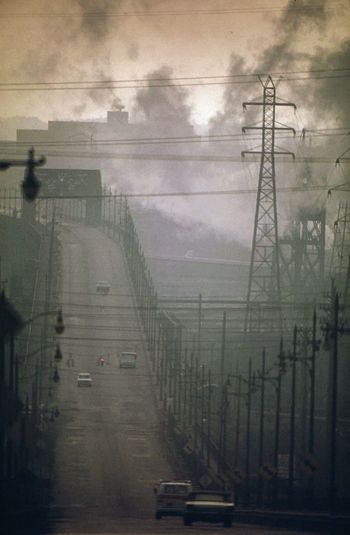
Effigy 1. Air pollution from industrial activity..[1]
The Coase theorem is a way to deal with the tragedy of the commons trouble surrounding common resources such as the environs. Ronald Coase is an economist who won a Nobel Prize for Economic science and developed his theory in 1960.[2] The coast theorem is a market-based solution to the negative externality created past pollution. The theory suggests that holding rights are non essential and that authorities intervention is not necessary simply rather, if parties can negotiate (without incurring excess cost) to correct a negative externality then the problem can be solved.[3]
Coase's theory states that if the actions of political party A harms party B, so political party B can create an incentive for party A to reduce or stop the action creating the harm. In short, i can bribe some other to end a harmful activity. To be articulate, this theorem assumes that the cost of bargaining is very depression or none at all.[four] This assumption breaks downwards in situations were there is unequal political or social power between party A and party B, see social license for farther discussion of this.
For example, in that location is a coal fired power plant that produces electricity and information technology was built before a small boondocks adult nearby. As the town adult, they became aware that the winds blew the pollution released from the plant into the town. One style to correct for this negative by-product of electrical generation would to be for the town to pay the coal found to install better air scrubbers, particulate matter collectors and other pollution control mechanisms in society to reduce the sick effects felt in the town. This move is said to exist pareto improving because it makes at least one party improve off without any other party being worse off every bit a result of the activity. If the cost of the new measures is $40,000 and the town offers a higher amount then both parties volition exist better off equally the town volition have higher air quality and the coal plant volition brand some money.
Property rights and Transaction Costs
Coase argues that holding rights are much less of a factor. Consider the case above, presume that the company is given the right to pollute the air around the factory and town. The town could nevertheless pay the coal plant to reduce its level of pollution without having to re-allocate the belongings rights to the air.[5]
Coase's theorem breaks down when the bargaining is expensive. If at that place's no ability to bargain, then an equitable solution can't be reached. In the case in a higher place the company may not be willing to talk with the people in the town without being forced to. Forcing the interaction will cost the town in legal fees. If the company is slow to human activity and then the disadvantage of breathing the polluted air for that time menses may non make it worthwhile for the town to pursue the negotiations. If the negotiations will take a very long time and due to legal and other fees cost more than than $40,000 than, co-ordinate to Coase, the effort is not worth pursuing. This means that transaction costs are the limiting factor for the Coase theorem.[half dozen] If dealing with the company directly is too expensive, then the town is farther ahead irresolute the 'property rights' of the company to pollute the air.
In full general though, whenever cost of dealing with the company is more than expensive than the harm created bythe externality then trying to set up the trouble isn't worth it.
Cap-and-Trade
Coase finds the pigouvian arrangement of externality control to be "faulty".[seven] Coase argues that in setting up a market place for pollution permits that firms can merchandise amongst themselves, the authorities tin can reach an efficient level of pollution without creating excess inefficiency in the marketplace.
In this way firms can decide amongst themselves who tin can pollute the nigh and in certain cases, firms volition be able to sell their permits for a turn a profit thus improving the economic incentive to pollute less and sell more permits to other firms.
See Also
- Tragedy of the commons
- Common resource
- Externality
- Negative externality
- Emissions trading
- Carbon taxation
- Pigouvian tax
References
- ↑ Wikimedia Eatables. [Online], Available: https://en.wikipedia.org/wiki/Air_pollution#/media/File:DARK_CLOUDS_OF_FACTORY_SMOKE_OBSCURE_CLARK_AVENUE_BRIDGE_-_NARA_-_550179.jpg [Aug 22, 2016]
- ↑ R.H. Coase. "The Problem of Social Cost," Journal of Law & Economics, vol. iii, pp. i-44, Oct. 1960.
- ↑ A. Goolsbee, S. Levitt and C. Syverson. Microeconomics. New York: Worth Publishers, 2013, pp. 667.
- ↑ A. Goolsbee, S. Levitt and C. Syverson. Microeconomics. pp. 670.
- ↑ H. Kohler. Intermediate Microeconomics: Theory and Applications. London: Scott, Foresman and Company, 1990, pp. 564-565.
- ↑ J.B. Taylor. Economic science. Boston: Houghton Mifflin Company, 1995, pp. 522-523.
- ↑ R.H. Coase. The Firm, the Market and the Police. Chicago: University of Chicago Printing, 1988, pp. 149.
Source: https://energyeducation.ca/encyclopedia/Coase_theorem

Post a Comment for "According to the Coase Theorem, the Private Market Can Achieve an Efficient Outcome:"