Part a - Reviewing Independent Assortment of Alleles
Mendel'south Laws of Heredity
Mendel formed the Laws of Heredity (the Police of Segregation and the Law of Independent Assortment) from his pea institute experiments.
Learning Objectives
Discuss the methods Mendel utilized in his research that led to his success in understanding the process of inheritance
Key Takeaways
Key Points
- Past crossing royal and white pea plants, Mendel constitute the offspring were purple rather than mixed, indicating ane color was dominant over the other.
- Mendel's Law of Segregation states individuals possess two alleles and a parent passes only 1 allele to his/her offspring.
- Mendel'south Law of Independent Assortment states the inheritance of i pair of factors ( genes ) is independent of the inheritance of the other pair.
- If the ii alleles are identical, the private is called homozygous for the trait; if the 2 alleles are different, the private is called heterozygous.
- Mendel cross-bred dihybrids and found that traits were inherited independently of each other.
Key Terms
- homozygous: of an organism in which both copies of a given gene take the aforementioned allele
- heterozygous: of an organism which has 2 different alleles of a given gene
- allele: one of a number of alternative forms of the same gene occupying a given position on a chromosome
Introduction
Mendelian inheritance (or Mendelian genetics or Mendelism) is a gear up of primary tenets relating to the manual of hereditary characteristics from parent organisms to their children; it underlies much of genetics. The tenets were initially derived from the piece of work of Gregor Mendel published in 1865 and 1866, which was "re-discovered" in 1900; they were initially very controversial, only they soon became the cadre of classical genetics.
The laws of inheritance were derived by Gregor Mendel, a 19th century monk conducting hybridization experiments in garden peas (Pisum sativum). Between 1856 and 1863, he cultivated and tested some 28,000 pea plants. From these experiments, he deduced 2 generalizations that afterward became known every bit Mendel's Laws of Heredity or Mendelian inheritance. He described these laws in a 2 function paper, "Experiments on Constitute Hybridization", which was published in 1866.
Mendel'due south Laws
Mendel discovered that by crossing true-breeding white flower and true-breeding purple flower plants, the result was a hybrid offspring. Rather than being a mix of the two colors, the offspring was majestic flowered. He then conceived the idea of heredity units, which he called "factors", one of which is a recessive feature and the other dominant. Mendel said that factors, later chosen genes, normally occur in pairs in ordinary body cells, yet segregate during the formation of sex cells. Each member of the pair becomes role of the separate sex cell. The dominant gene, such as the purple flower in Mendel's plants, will hide the recessive cistron, the white flower. After Mendel self-fertilized the F1 generation and obtained an F2 generation with a 3:1 ratio, he correctly theorized that genes tin can exist paired in three different ways for each trait: AA, aa, and Aa. The majuscule A represents the dominant gene while the lowercase a represents the recessive.

Mendel's Pea Plants: In one of his experiments on inheritance patterns, Mendel crossed plants that were truthful-breeding for violet blossom color with plants true-convenance for white flower color (the P generation). The resulting hybrids in the F1 generation all had violet flowers. In the F2 generation, approximately three-quarters of the plants had violet flowers, and one-quarter had white flowers.
Mendel stated that each individual has two alleles for each trait, ane from each parent. Thus, he formed the "first rule", the Constabulary of Segregation, which states individuals possess two alleles and a parent passes but one allele to his/her offspring. One allele is given by the female parent and the other is given past the male parent. The two factors may or may non incorporate the same information. If the two alleles are identical, the individual is called homozygous for the trait. If the two alleles are unlike, the individual is called heterozygous. The presence of an allele does not promise that the trait will be expressed in the individual that possesses it. In heterozygous individuals, the only allele that is expressed is the ascendant. The recessive allele is present, merely its expression is hidden. The genotype of an individual is fabricated up of the many alleles it possesses. An individual's physical appearance, or phenotype, is determined past its alleles as well as by its environment.
Mendel also analyzed the pattern of inheritance of seven pairs of contrasting traits in the domestic pea plant. He did this by cross-convenance dihybrids; that is, plants that were heterozygous for the alleles controlling two different traits. Mendel then crossed these dihybrids. If it is inevitable that round seeds must always be yellow and wrinkled seeds must be green, and then he would have expected that this would produce a typical monohybrid cross: 75 per centum round-yellow; 25 percent wrinkled-green. Just, in fact, his mating generated seeds that showed all possible combinations of the colour and texture traits. He found ix/16 of the offspring were round-yellow, 3/16 were round-green, 3/16 were wrinkled-yellow, and 1/xvi were wrinkled-green. Finding in every case that each of his seven traits was inherited independently of the others, he formed his "2nd dominion", the Law of Independent Array, which states the inheritance of one pair of factors (genes) is independent of the inheritance of the other pair. Today we know that this rule holds only if the genes are on separate chromosomes
Mendel'due south Law of Dominance
In a heterozygote, the allele which masks the other is referred to as ascendant, while the allele that is masked is referred to every bit recessive.
Learning Objectives
Explain the concept of say-so versus recessiveness
Central Takeaways
Key Points
- Dominant alleles are expressed exclusively in a heterozygote, while recessive traits are expressed only if the organism is homozygous for the recessive allele.
- A unmarried allele may exist dominant over one allele, but recessive to another.
- Non all traits are controlled by uncomplicated dominance equally a course of inheritance; more complex forms of inheritance accept been found to exist.
Fundamental Terms
- dominant: a relationship between alleles of a factor, in which ane allele masks the expression (phenotype) of some other allele at the same locus
- recessive: able to exist covered up by a dominant trait
Alleles Can Be Dominant or Recessive
Most familiar animals and some plants have paired chromosomes and are described as diploid. They have ii versions of each chromosome: one contributed by the female parent in her ovum and one by the male person parent in his sperm. These are joined at fertilization. The ovum and sperm cells (the gametes) accept only one copy of each chromosome and are described every bit haploid.
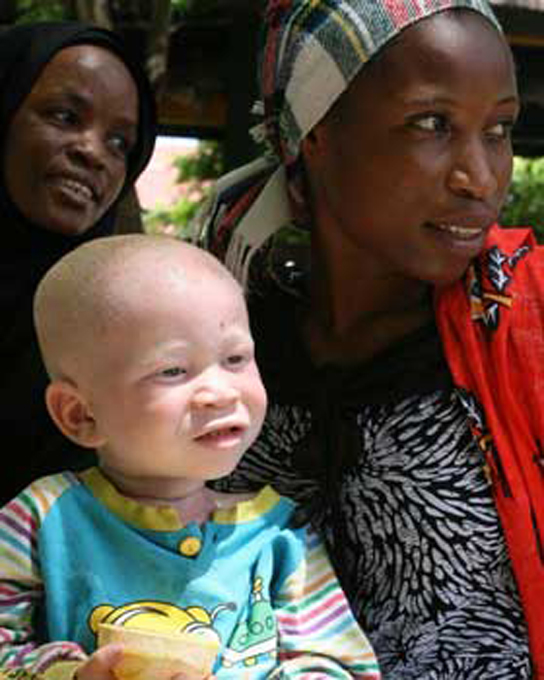
Recessive traits are just visible if an individual inherits ii copies of the recessive allele: The kid in the photograph expresses albinism, a recessive trait.
Mendel's constabulary of say-so states that in a heterozygote, one trait will conceal the presence of another trait for the same feature. Rather than both alleles contributing to a phenotype, the dominant allele will exist expressed exclusively. The recessive allele will remain "latent," just volition be transmitted to offspring by the same manner in which the dominant allele is transmitted. The recessive trait will merely be expressed by offspring that have two copies of this allele; these offspring will breed truthful when self-crossed.
Past definition, the terms dominant and recessive refer to the genotypic interaction of alleles in producing the phenotype of the heterozygote. The fundamental concept is genetic: which of the ii alleles present in the heterozygote is expressed, such that the organism is phenotypically identical to one of the two homozygotes. It is sometimes user-friendly to talk virtually the trait corresponding to the ascendant allele every bit the dominant trait and the trait respective to the hidden allele as the recessive trait. However, this tin easily lead to confusion in understanding the concept as phenotypic. For example, to say that "green peas" dominate "yellow peas" confuses inherited genotypes and expressed phenotypes. This volition subsequently misfile discussion of the molecular basis of the phenotypic difference. Authorization is not inherent. I allele can be ascendant to a second allele, recessive to a third allele, and codominant to a 4th. If a genetic trait is recessive, a person needs to inherit ii copies of the gene for the trait to be expressed. Thus, both parents have to be carriers of a recessive trait in society for a child to express that trait.
Since Mendel'due south experiments with pea plants, other researchers have found that the law of dominance does not always agree truthful. Instead, several different patterns of inheritance accept been found to exist.
Mendel's Constabulary of Segregation
Mendel's Constabulary of Segregation states that a diploid organism passes a randomly selected allele for a trait to its offspring, such that the offspring receives one allele from each parent.
Learning Objectives
Utilize the law of segregation to determine the chances of a detail genotype arising from a genetic cantankerous
Key Takeaways
Central Points
- Each gamete acquires one of the two alleles equally chromosomes separate into dissimilar gametes during meiosis.
- Heterozygotes, which posess i dominant and ane recessive allele, can receive each allele from either parent and will look identical to homozygous dominant individuals; the Law of Segregation supports Mendel'due south observed 3:i phenotypic ratio.
- Mendel proposed the Law of Segregation subsequently observing that pea plants with two different traits produced offspring that all expressed the ascendant trait, just the following generation expressed the dominant and recessive traits in a 3:1 ratio.
Cardinal Terms
- constabulary of segregation: a diploid individual possesses a pair of alleles for any particular trait and each parent passes ane of these randomly to its offspring
Equal Segregation of Alleles
Observing that true-breeding pea plants with contrasting traits gave ascent to Fone generations that all expressed the dominant trait and Fii generations that expressed the ascendant and recessive traits in a 3:1 ratio, Mendel proposed the law of segregation. The law of segregation states that each private that is a diploid has a pair of alleles (copy) for a particular trait. Each parent passes an allele at random to their offspring resulting in a diploid organism. The allele that contains the ascendant trait determines the phenotype of the offspring. In essence, the police states that copies of genes dissever or segregate so that each gamete receives simply one allele.

The Police force of Segregation states that alleles segregate randomly into gametes: When gametes are formed, each allele of i parent segregates randomly into the gametes, such that one-half of the parent'southward gametes behave each allele.
For the Ftwo generation of a monohybrid cross, the post-obit three possible combinations of genotypes could result: homozygous ascendant, heterozygous, or homozygous recessive. Because heterozygotes could arise from two dissimilar pathways (receiving one dominant and one recessive allele from either parent), and because heterozygotes and homozygous dominant individuals are phenotypically identical, the police supports Mendel's observed 3:1 phenotypic ratio. The equal segregation of alleles is the reason we tin employ the Punnett square to accurately predict the offspring of parents with known genotypes.
The physical basis of Mendel's law of segregation is the first segmentation of meiosis in which the homologous chromosomes with their unlike versions of each cistron are segregated into daughter nuclei. The beliefs of homologous chromosomes during meiosis can account for the segregation of the alleles at each genetic locus to different gametes. As chromosomes separate into different gametes during meiosis, the two different alleles for a detail factor also segregate then that each gamete acquires 1 of the two alleles. In Mendel's experiments, the segregation and the independent assortment during meiosis in the F1 generation give ascent to the F2 phenotypic ratios observed past Mendel. The function of the meiotic segregation of chromosomes in sexual reproduction was not understood by the scientific community during Mendel'southward lifetime.
Mendel's Law of Independent Array
Independent assortment allows the calculation of genotypic and phenotypic ratios based on the probability of individual factor combinations.
Learning Objectives
Use the probability or forked line method to summate the run a risk of any particular genotype arising from a genetic cross
Central Takeaways
Key Points
- Mendel'due south law of contained assortment states that genes do not influence each other with regard to the sorting of alleles into gametes; every possible combination of alleles for every gene is equally probable to occur.
- The adding of any particular genotypic combination of more than one gene is, therefore, the probability of the desired genotype at the first locus multiplied past the probability of the desired genotype at the other loci.
- The forked line method can be used to summate the chances of all possible genotypic combinations from a cross, while the probability method tin exist used to calculate the chance of whatever one item genotype that might outcome from that cross.
Cardinal Terms
- independent assortment: separate genes for separate traits are passed independently of one some other from parents to offspring
Independent Assortment
Mendel'southward law of independent assortment states that genes do not influence each other with regard to the sorting of alleles into gametes: every possible combination of alleles for every gene is equally likely to occur. The independent array of genes tin exist illustrated by the dihybrid cantankerous: a cross between two true-breeding parents that limited unlike traits for two characteristics. Consider the characteristics of seed color and seed texture for 2 pea plants: one that has green, wrinkled seeds (yyrr) and another that has xanthous, round seeds (YYRR). Because each parent is homozygous, the law of segregation indicates that the gametes for the green/wrinkled plant all are twelvemonth, while the gametes for the yellow/round establish are all YR. Therefore, the F1 generation of offspring all are YyRr.
For the F2 generation, the constabulary of segregation requires that each gamete receive either an R allele or an r allele forth with either a Y allele or a y allele. The law of contained array states that a gamete into which an r allele sorted would be equally probable to comprise either a Y allele or a y allele. Thus, at that place are iv as likely gametes that tin can be formed when the YyRr heterozygote is self-crossed equally follows: YR, Yr, year, and twelvemonth. Arranging these gametes along the top and left of a 4 × iv Punnett square gives united states of america 16 equally likely genotypic combinations. From these genotypes, we infer a phenotypic ratio of 9 round/yellowish:3 round/dark-green:3 wrinkled/xanthous:i wrinkled/dark-green. These are the offspring ratios we would wait, assuming nosotros performed the crosses with a large enough sample size.
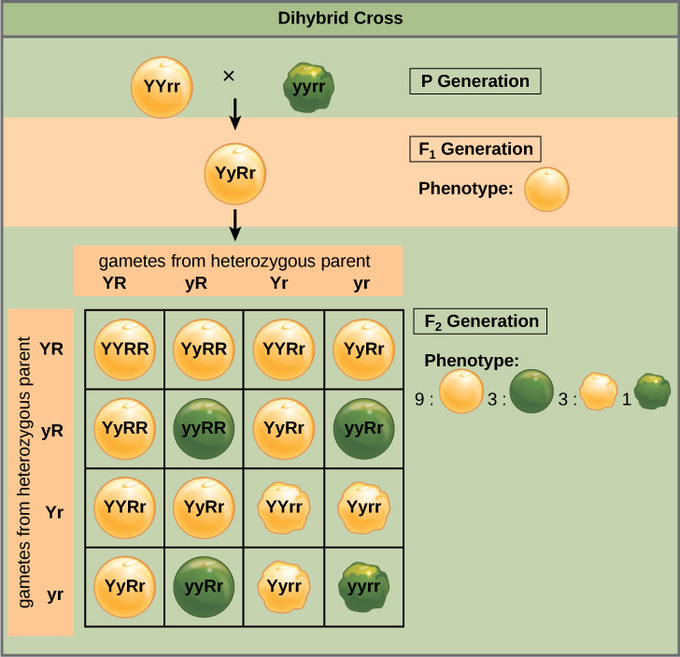
Independent assortment of 2 genes: This dihybrid cross of pea plants involves the genes for seed color and texture.
Because of contained assortment and dominance, the 9:three:3:1 dihybrid phenotypic ratio can be collapsed into two 3:1 ratios, characteristic of any monohybrid cross that follows a ascendant and recessive pattern. Ignoring seed color and considering only seed texture in the above dihybrid cross, we would look that iii-quarters of the F2 generation offspring would be round and i-quarter would be wrinkled. Similarly, isolating simply seed colour, we would assume that iii-quarters of the F2 offspring would be yellow and ane-quarter would exist green. The sorting of alleles for texture and color are contained events, so nosotros can employ the product rule. Therefore, the proportion of circular and yellowish F2 offspring is expected to be (iii/4) × (3/4) = 9/16, and the proportion of wrinkled and dark-green offspring is expected to be (1/4) × (1/4) = ane/16. These proportions are identical to those obtained using a Punnett square. Circular/green and wrinkled/yellowish offspring can also be calculated using the product dominion equally each of these genotypes includes one dominant and one recessive phenotype. Therefore, the proportion of each is calculated as (3/four) × (1/4) = 3/16.
Forked-Line Method
When more than 2 genes are being considered, the Punnett-square method becomes unwieldy. For instance, examining a cross involving four genes would require a 16 × xvi grid containing 256 boxes. Information technology would exist extremely cumbersome to manually enter each genotype. For more complex crosses, the forked-line and probability methods are preferred.
To set up a forked-line diagram for a cross between F1 heterozygotes resulting from a cantankerous between AABBCC and aabbcc parents, we first create rows equal to the number of genes being considered and then segregate the alleles in each row on forked lines co-ordinate to the probabilities for individual monohybrid crosses. We then multiply the values forth each forked path to obtain the F2 offspring probabilities. Annotation that this process is a diagrammatic version of the product dominion. The values along each forked pathway tin be multiplied because each cistron assorts independently. For a trihybrid cross, the Fii phenotypic ratio is 27:9:nine:9:3:3:iii:1.

Independent assortment of 3 genes: The forked-line method can exist used to clarify a trihybrid cross. Here, the probability for color in the F2 generation occupies the top row (3 yellow:1 green). The probability for shape occupies the 2d row (3 round:1 wrinked), and the probability for height occupies the 3rd row (3 alpine:i dwarf). The probability for each possible combination of traits is calculated by multiplying the probability for each individual trait. Thus, the probability of F2 offspring having yellow, circular, and tall traits is 3 × 3 × 3, or 27.
Probability Method
While the forked-line method is a diagrammatic arroyo to keeping track of probabilities in a cantankerous, the probability method gives the proportions of offspring expected to exhibit each phenotype (or genotype) without the added visual assistance.
To fully demonstrate the power of the probability method, however, we can consider specific genetic calculations. For instance, for a tetrahybrid cross between individuals that are heterozygotes for all 4 genes, and in which all iv genes are sorting independently in a dominant and recessive design, what proportion of the offspring will be expected to exist homozygous recessive for all 4 alleles? Rather than writing out every possible genotype, we can use the probability method. We know that for each factor the fraction of homozygous recessive offspring will be 1/four. Therefore, multiplying this fraction for each of the four genes, (1/four) × (ane/4) × (i/four) × (1/4), nosotros determine that ane/256 of the offspring will exist quadruply homozygous recessive.
Genetic Linkage and Violation of the Law of Independent Assortment
Genes that are on the same chromosome, or "linked", do not assort independently, but can exist separated by recombination.
Learning Objectives
Describe how recombination tin can split up linked genes
Cardinal Takeaways
Key Points
- Two genes close together on the same chromosome tend to be inherited together and are said to be linked.
- Linked genes can be separated past recombination in which homologous chromosomes exchange genetic information during meiosis; this results in parental, or nonrecombinant genotypes, equally well as a smaller proportion of recombinant genotypes.
- Geneticists can use the amount of recombination between genes to estimate the altitude between them on a chromosome.
Key Terms
- linkage: the belongings of genes of existence inherited together
- recombination: the germination of genetic combinations in offspring that are non present in the parents
Linked Genes Violate the Law of Independent Assortment
Although all of Mendel's pea characteristics behaved according to the constabulary of independent assortment, we now know that some allele combinations are non inherited independently of each other. Genes that are located on separate non-homologous chromosomes will e'er sort independently. However, each chromosome contains hundreds or thousands of genes organized linearly on chromosomes similar beads on a string. The segregation of alleles into gametes tin can be influenced by linkage, in which genes that are located physically close to each other on the same chromosome are more than likely to be inherited as a pair. Yet, because of the process of recombination, or "crossover," information technology is possible for two genes on the same chromosome to comport independently, or as if they are non linked. To sympathise this, allow's consider the biological basis of factor linkage and recombination.

Unlinked genes assort independently: This figure shows all possible combinations of offspring resulting from a dihybrid cross of pea plants that are heterozygous for the tall/dwarf and inflated/constricted alleles.
Homologous chromosomes possess the aforementioned genes in the same linear order. The alleles may differ on homologous chromosome pairs, just the genes to which they correspond exercise not. In grooming for the commencement partition of meiosis, homologous chromosomes replicate and synapse. Like genes on the homologs align with each other. At this stage, segments of homologous chromosomes exchange linear segments of genetic material. This process is chosen recombination, or crossover, and information technology is a common genetic procedure. Considering the genes are aligned during recombination, the gene order is not altered. Instead, the upshot of recombination is that maternal and paternal alleles are combined onto the same chromosome. Across a given chromosome, several recombination events may occur, causing all-encompassing shuffling of alleles.

Linked genes can be separated by recombination: The procedure of crossover, or recombination, occurs when two homologous chromosomes align during meiosis and exchange a segment of genetic material. Here, the alleles for gene C were exchanged. The issue is 2 recombinant and 2 non-recombinant chromosomes.
When two genes are located in shut proximity on the aforementioned chromosome, they are considered linked, and their alleles tend to be transmitted through meiosis together. To exemplify this, imagine a dihybrid cross involving blossom color and plant pinnacle in which the genes are next to each other on the chromosome. If ane homologous chromosome has alleles for tall plants and red flowers, and the other chromosome has genes for short plants and xanthous flowers, and so when the gametes are formed, the tall and red alleles will become together into a gamete and the short and yellow alleles volition go into other gametes. These are called the parental genotypes because they have been inherited intact from the parents of the individual producing gametes. But dissimilar if the genes were on different chromosomes, there volition be no gametes with tall and yellow alleles and no gametes with brusque and reddish alleles. If yous create the Punnett square with these gametes, you will run into that the classical Mendelian prediction of a nine:3:3:one upshot of a dihybrid cross would not utilize. As the distance between two genes increases, the probability of ane or more crossovers between them increases, and the genes behave more than similar they are on separate chromosomes. Geneticists have used the proportion of recombinant gametes (the ones not like the parents) as a measure of how far apart genes are on a chromosome. Using this information, they have constructed elaborate maps of genes on chromosomes for well-studied organisms, including humans.
Mendel'south seminal publication makes no mention of linkage, and many researchers accept questioned whether he encountered linkage, but chose not to publish those crosses out of concern that they would invalidate his independent assortment postulate. The garden pea has vii chromosomes and some have suggested that his selection of seven characteristics was non a coincidence. However, even if the genes he examined were not located on separate chromosomes, it is possible that he only did not find linkage because of the all-encompassing shuffling effects of recombination.
Epistasis
Epistasis occurs when ane gene masks or interferes with the expression of another.
Learning Objectives
Explain the phenotypic outcomes of epistatic effects between genes
Key Takeaways
Fundamental Points
- In many cases, several genes may contribute to a particular phenotype; when the actions of ane gene masks the effects of another, this factor is said to exist epistatic to the second.
- Epistasis can occur when a recessive genotype masks the actions of another gene, or when a dominant allele masks the effects of another gene.
- Epistasis can be reciprocal: either gene, when present in the dominant (or recessive) form, expresses the aforementioned phenotype.
- Whatever single characteristic that results in a phenotypic ratio that totals sixteen (such as 12:three:1, 9:3:4, or others) is typical of a ii-gene interaction.
Cardinal Terms
- epistasis: the modification of the expression of a cistron past another unrelated 1
Epistasis
Mendel's studies in pea plants unsaid that the sum of an individual'due south phenotype was controlled past genes (or equally he called them, unit factors): every characteristic was distinctly and completely controlled by a unmarried cistron. In fact, single observable characteristics are almost always under the influence of multiple genes (each with ii or more alleles) acting in unison. For example, at least eight genes contribute to eye color in humans.
In some cases, several genes tin can contribute to aspects of a mutual phenotype without their gene products ever straight interacting. In the case of organ evolution, for instance, genes may exist expressed sequentially, with each cistron adding to the complexity and specificity of the organ. Genes may function in complementary or synergistic fashions: 2 or more genes need to be expressed simultaneously to bear upon a phenotype. Genes may likewise oppose each other with one gene modifying the expression of another.
In epistasis, the interaction between genes is antagonistic: one gene masks or interferes with the expression of another. "Epistasis" is a word composed of Greek roots that hateful "standing upon." The alleles that are being masked or silenced are said to exist hypostatic to the epistatic alleles that are doing the masking. Often the biochemical footing of epistasis is a gene pathway in which the expression of ane factor is dependent on the function of a gene that precedes or follows it in the pathway.
An example of epistasis is pigmentation in mice. The wild-blazon coat color, agouti (AA), is ascendant to solid-colored fur (aa). However, a separate gene (C) is necessary for pigment production. A mouse with a recessive c allele at this locus is unable to produce pigment and is albino regardless of the allele present at locus A. Therefore, the genotypes AAcc, Aacc, and aacc all produce the same albino phenotype. A cross between heterozygotes for both genes (AaCc 10 AaCc) would generate offspring with a phenotypic ratio of ix agouti:three solid colour:iv albino. In this example, the C gene is epistatic to the A gene.

Epistasis in mouse coat colour: In mice, the mottled agouti coat colour (A) is dominant to a solid coloration, such equally black or gray. A cistron at a dissever locus (C) is responsible for pigment production. The recessive c allele does not produce pigmentnand a mouse with the homozygous recessive cc genotype is albino regardless of the allele present at the A locus. Thus, the C gene is epistatic to the A gene.
Epistasis can likewise occur when a dominant allele masks expression at a separate gene. Fruit colour in summertime squash is expressed in this manner. Homozygous recessive expression of the Due west gene (ww) coupled with homozygous dominant or heterozygous expression of the Y gene (YY or Yy) generates yellow fruit, while the wwyy genotype produces green fruit. However, if a ascendant copy of the W factor is nowadays in the homozygous or heterozygous course, the summertime squash volition produce white fruit regardless of the Y alleles. A cantankerous between white heterozygotes for both genes (WwYy × WwYy) would produce offspring with a phenotypic ratio of 12 white:3 yellowish:1 greenish.
Finally, epistasis can be reciprocal: either factor, when nowadays in the dominant (or recessive) grade, expresses the aforementioned phenotype. In the shepherd'south handbag plant (Capsella bursa-pastoris), the characteristic of seed shape is controlled past two genes in a dominant epistatic human relationship. When the genes A and B are both homozygous recessive (aabb), the seeds are ovoid. If the ascendant allele for either of these genes is present, the effect is triangular seeds. That is, every possible genotype other than aabb results in triangular seeds; a cantankerous between heterozygotes for both genes (AaBb ten AaBb) would yield offspring with a phenotypic ratio of 15 triangular:ane ovoid.
Keep in heed that any single characteristic that results in a phenotypic ratio that totals sixteen is typical of a two-gene interaction. Recall the phenotypic inheritance design for Mendel's dihybrid cross, which considered ii not-interacting genes: ix:3:three:ane. Similarly, nosotros would await interacting factor pairs to also exhibit ratios expressed every bit xvi parts. Note that nosotros are assuming the interacting genes are not linked; they are still assorting independently into gametes.
Source: https://courses.lumenlearning.com/boundless-biology/chapter/laws-of-inheritance/

Post a Comment for "Part a - Reviewing Independent Assortment of Alleles"