What do the nucleus, ER, ribosomes, Golgi apparatus, and vesicles work together to do?
The Nucleus and Ribosomes
Institute inside eukaryotic cells, the nucleus contains the genetic material that determines the unabridged structure and function of that cell.
Learning Objectives
Explain the purpose of the nucleus in eukaryotic cells
Key Takeaways
Key Points
- The nucleus contains the prison cell 'southward Dna and directs the synthesis of ribosomes and proteins.
- Found within the nucleoplasm, the nucleolus is a condensed region of chromatin where ribosome synthesis occurs.
- Chromatin consists of DNA wrapped around histone proteins and is stored inside the nucleoplasm.
- Ribosomes are large complexes of protein and ribonucleic acid (RNA) responsible for poly peptide synthesis when DNA from the nucleus is transcribed.
Key Terms
- histone: any of various simple water-soluble proteins that are rich in the basic amino acids lysine and arginine and are complexed with Dna in the nucleosomes of eukaryotic chromatin
- nucleolus: a conspicuous, rounded, non-membrane spring torso inside the nucleus of a prison cell
- chromatin: a complex of DNA, RNA, and proteins within the jail cell nucleus out of which chromosomes condense during cell partition
The Nucleus
One of the main differences between prokaryotic and eukaryotic cells is the nucleus. Every bit previously discussed, prokaryotic cells lack an organized nucleus while eukaryotic cells comprise membrane-jump nuclei (and organelles ) that house the cell's DNA and directly the synthesis of ribosomes and proteins.
The nucleus stores chromatin (Deoxyribonucleic acid plus proteins) in a gel-similar substance called the nucleoplasm. To understand chromatin, it is helpful to kickoff consider chromosomes. Chromatin describes the material that makes up chromosomes, which are structures inside the nucleus that are made up of DNA, the hereditary material. You may remember that in prokaryotes, DNA is organized into a unmarried circular chromosome. In eukaryotes, chromosomes are linear structures. Every eukaryotic species has a specific number of chromosomes in the nuclei of its torso's cells. For instance, in humans, the chromosome number is 46, while in fruit flies, it is eight. Chromosomes are only visible and distinguishable from one another when the jail cell is getting ready to split up. In order to organize the big amount of Dna inside the nucleus, proteins called histones are attached to chromosomes; the Dna is wrapped effectually these histones to class a structure resembling chaplet on a string. These protein-chromosome complexes are called chromatin.

DNA is highly organized: This image shows various levels of the organization of chromatin (DNA and protein). Forth the chromatin threads, unwound protein-chromosome complexes, we detect DNA wrapped around a set of histone proteins.
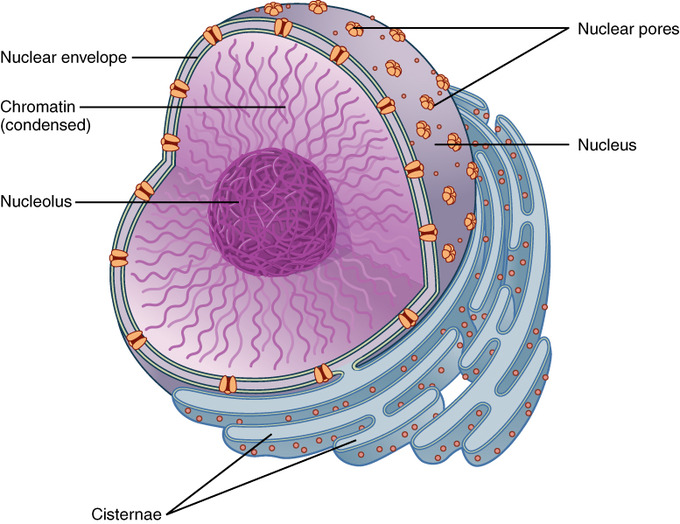
The nucleus stores the hereditary material of the cell: The nucleus is the command middle of the jail cell. The nucleus of living cells contains the genetic material that determines the unabridged construction and function of that prison cell.
The nucleoplasm is too where we find the nucleolus. The nucleolus is a condensed region of chromatin where ribosome synthesis occurs. Ribosomes, large complexes of protein and ribonucleic acid (RNA), are the cellular organelles responsible for protein synthesis. They receive their "orders" for protein synthesis from the nucleus where the DNA is transcribed into messenger RNA (mRNA). This mRNA travels to the ribosomes, which translate the lawmaking provided past the sequence of the nitrogenous bases in the mRNA into a specific guild of amino acids in a protein.

Ribosomes are responsible for protein synthesis: Ribosomes are fabricated up of a big subunit (meridian) and a small subunit (lesser). During protein synthesis, ribosomes assemble amino acids into proteins.
Lastly, the boundary of the nucleus is chosen the nuclear envelope. It consists of two phospholipid bilayers: an outer membrane and an inner membrane. The nuclear membrane is continuous with the endoplasmic reticulum, while nuclear pores allow substances to enter and exit the nucleus.
Characteristics of Eukaryotic Cells
A eukaryotic cell has a truthful membrane-bound nucleus and has other membranous organelles that let for compartmentalization of functions.
Learning Objectives
Depict the structure of eukaryotic cells
Central Takeaways
Central Points
- Eukaryotic cells are larger than prokaryotic cells and take a "true" nucleus, membrane-bound organelles, and rod-shaped chromosomes.
- The nucleus houses the cell'due south Dna and directs the synthesis of proteins and ribosomes.
- Mitochondria are responsible for ATP production; the endoplasmic reticulum modifies proteins and synthesizes lipids; and the golgi appliance is where the sorting of lipids and proteins takes place.
- Peroxisomes carry out oxidation reactions that suspension down fatty acids and amino acids and detoxify poisons; vesicles and vacuoles function in storage and transport.
- Fauna cells take a centrosome and lysosomes while plant cells exercise non.
- Plant cells have a jail cell wall, a large central vacuole, chloroplasts, and other specialized plastids, whereas brute cells do not.
Key Terms
- eukaryotic: Having complex cells in which the genetic material is organized into membrane-leap nuclei.
- organelle: A specialized structure found within cells that carries out a specific life procedure (e.grand. ribosomes, vacuoles).
- photosynthesis: the process past which plants and other photoautotrophs generate carbohydrates and oxygen from carbon dioxide, water, and light energy in chloroplasts
Eukaryotic Cell Structure
Like a prokaryotic prison cell, a eukaryotic cell has a plasma membrane, cytoplasm, and ribosomes. However, unlike prokaryotic cells, eukaryotic cells have:
- a membrane-bound nucleus
- numerous membrane-bound organelles (including the endoplasmic reticulum, Golgi apparatus, chloroplasts, and mitochondria)
- several rod-shaped chromosomes
Because a eukaryotic cell's nucleus is surrounded past a membrane, information technology is often said to have a "truthful nucleus." Organelles (meaning "little organ") accept specialized cellular roles, but equally the organs of your body have specialized roles. They permit unlike functions to be compartmentalized in unlike areas of the jail cell.
The Nucleus & Its Structures
Typically, the nucleus is the most prominent organelle in a cell. Eukaryotic cells have a true nucleus, which means the prison cell'south DNA is surrounded by a membrane. Therefore, the nucleus houses the cell'due south Dna and directs the synthesis of proteins and ribosomes, the cellular organelles responsible for protein synthesis. The nuclear envelope is a double-membrane structure that constitutes the outermost portion of the nucleus. Both the inner and outer membranes of the nuclear envelope are phospholipid bilayers. The nuclear envelope is punctuated with pores that command the passage of ions, molecules, and RNA between the nucleoplasm and cytoplasm. The nucleoplasm is the semi-solid fluid inside the nucleus where we observe the chromatin and the nucleolus. Furthermore, chromosomes are structures inside the nucleus that are made upwards of DNA, the genetic material. In prokaryotes, DNA is organized into a single circular chromosome. In eukaryotes, chromosomes are linear structures.

Eukaryotic Nucleus: The nucleus stores chromatin (Deoxyribonucleic acid plus proteins) in a gel-like substance called the nucleoplasm.The nucleolus is a condensed region of chromatin where ribosome synthesis occurs.The boundary of the nucleus is called the nuclear envelope.It consists of 2 phospholipid bilayers: an outer membrane and an inner membrane.The nuclear membrane is continuous with the endoplasmic reticulum.Nuclear pores allow substances to enter and exit the nucleus.
Other Membrane-Spring Organelles
Mitochondria are oval-shaped, double membrane organelles that have their ain ribosomes and DNA. These organelles are often called the "energy factories" of a cell because they are responsible for making adenosine triphosphate (ATP), the jail cell's main energy-carrying molecule, by conducting cellular respiration. The endoplasmic reticulum modifies proteins and synthesizes lipids, while the golgi apparatus is where the sorting, tagging, packaging, and distribution of lipids and proteins takes place. Peroxisomes are small, round organelles enclosed by single membranes; they comport out oxidation reactions that break down fatty acids and amino acids. Peroxisomes also detoxify many poisons that may enter the body. Vesicles and vacuoles are membrane-bound sacs that function in storage and transport. Other than the fact that vacuoles are somewhat larger than vesicles, in that location is a very subtle distinction between them: the membranes of vesicles tin fuse with either the plasma membrane or other membrane systems inside the cell. All of these organelles are plant in each and every eukaryotic jail cell.
Animal Cells Versus Plant Cells
While all eukaryotic cells contain the aforementioned organelles and structures, there are some hitting differences between animal and found cells. Animal cells have a centrosome and lysosomes, whereas plant cells practise non. The centrosome is a microtubule-organizing center constitute almost the nuclei of animal cells while lysosomes take care of the cell's digestive procedure.

Animal Cells: Despite their fundamental similarities, there are some striking differences between animal and plant cells.Beast cells have centrioles, centrosomes, and lysosomes, whereas plant cells exercise not.
In improver, plant cells have a cell wall, a big fundamental vacuole, chloroplasts, and other specialized plastids, whereas animal cells do not. The cell wall protects the cell, provides structural back up, and gives shape to the cell while the central vacuole plays a key role in regulating the cell's concentration of water in irresolute environmental conditions. Chloroplasts are the organelles that deport out photosynthesis.

Plant Cells: Institute cells accept a cell wall, chloroplasts, plasmodesmata, and plastids used for storage, and a large central vacuole, whereas animal cells practice not.
Source: https://courses.lumenlearning.com/boundless-ap/chapter/the-nucleus-and-ribosomes/

Post a Comment for "What do the nucleus, ER, ribosomes, Golgi apparatus, and vesicles work together to do?"